.png)


How a Financial Services Enterprise Improved Real Customer Conversations at Scale

Financial Services Case Study
Company: Leading Financial Services Enterprise (NBFC + Distribution)
Employees: 12,000+ frontline workforce across branches and field teams
Industry: Financial Services (Lending, Distribution, Collections)
Languages: 8 Indian languages live — with more rolling out in planned waves
Challenge: Frontline teams were trained — but not consistently performing in real customer conversations.
Solution: A daily readiness rhythm — one scenario-based practice every day, one AI role play every week — built from the organization's own customer situations, delivered in each employee's own language, inside the flow of work.
Impact:
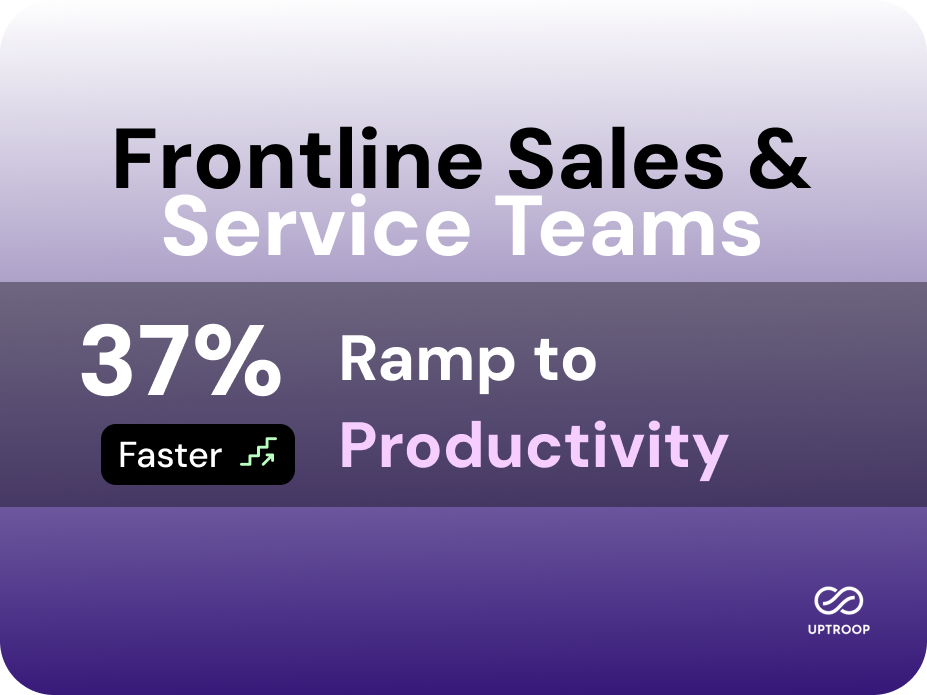
- 37% faster ramp to productivity
- 30% reduction in early performance drop-offs
- Higher consistency in customer conversations across regions and languages
- Reduced dependency on managers for coaching
The Challenge
The organization had already invested where most large enterprises invest:
- Product training
- SOPs and process documentation
- Compliance modules
But on the ground:
- Conversations varied widely across teams, regions and languages
- New hires took months to become effective
- Managers were heavily involved in hand-holding
- Critical moments — objections, lead generation, compliance-sensitive queries — were handled inconsistently
And there was a structural problem most training programs ignore: a 12,000-person frontline workforce that works in eight different languages, largely on mobile, spread across branches and field locations with no time for classroom sessions. English-language e-learning modules were being completed — and not changing what happened in front of the customer.
The gap was clear: teams had knowledge. Execution in real situations was unpredictable.
The Ask
The business wasn't looking for more training. They needed:
- Faster readiness for new hires
- Consistency in customer-facing conversations — across every region and language
- Reduced reliance on managers for repetitive coaching
- Measurable improvement in frontline performance, visible to leadership
UpTroop's Approach
1. Scenarios curated from the business, not a content library
Before a single practice went out, scenarios were built from the organization's actual customer situations — curated with zonal heads and business leaders who know exactly where conversations break down:
- EMI hesitation and rate objections
- Loan eligibility conversations
- Competitor Comparison ("IYour competitor is offering better rates")
- Compliance-sensitive queries requiring exact disclosures
This meant frontline teams weren't consuming generic sales content. They were practicing the precise moments their own leadership had flagged as make-or-break — with evaluation criteria (objection handling, need discovery, professional greeting, rapport building) defined by the business itself.
2. A daily readiness rhythm — at 12,000-user scale
Not a course to finish. A habit to build:
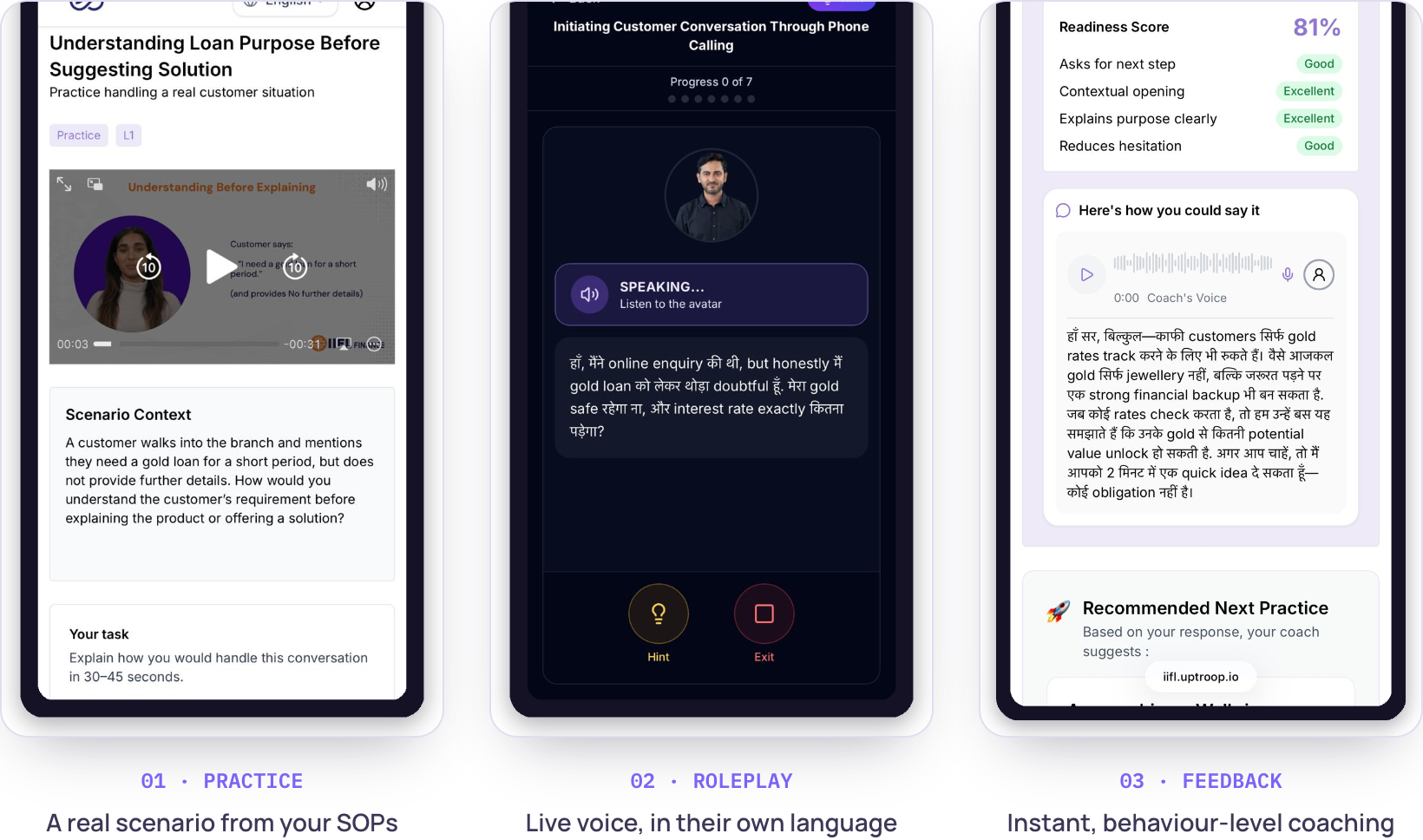
- One scenario-based practice every day — a 3–5 minute situation with instant feedback
- One AI role play every week — a live, voice-based conversation with an AI customer who hesitates, objects and pushes back the way real customers do
Delivered inside the tools teams already use. Access was built for zero friction from both directions: WhatsApp-based login with OTP for frontline teams on their phones, and enterprise SSO integrated with the client's identity systems — so every one of the 12,000 employees could sign in seconds, no new passwords, no new app to learn. The result: practice that actually happens, daily, across the full workforce — not a training week that fades.
3. In their own language — not translated at them
Every practice and role play runs in the employee's own language — eight live and counting — each with its own native AI coach voice, localized for how customers in that region actually speak.
This changed the relationship with practice itself. Teams weren't decoding English content about conversations they conduct in Marathi or Kannada — they were rehearsing the real conversation, in the real language. Adoption made the point better than any metric: employees began practicing in languages ahead of their official rollout, unprompted.
4. AI coaching on what teams actually say
After every practice and role play, each employee gets specific, private feedback on their own words:
- What worked, what didn't, and what to say next time
- A Readiness Score with skill-by-skill breakdowns — objection handling, clarity, compliance language, empathy
- A retry to beat their own score
The shift: from "knowing" → "doing better" — with a coach available to all 12,000 people, every day, in their language.
5. Visibility that turned managers into coaches
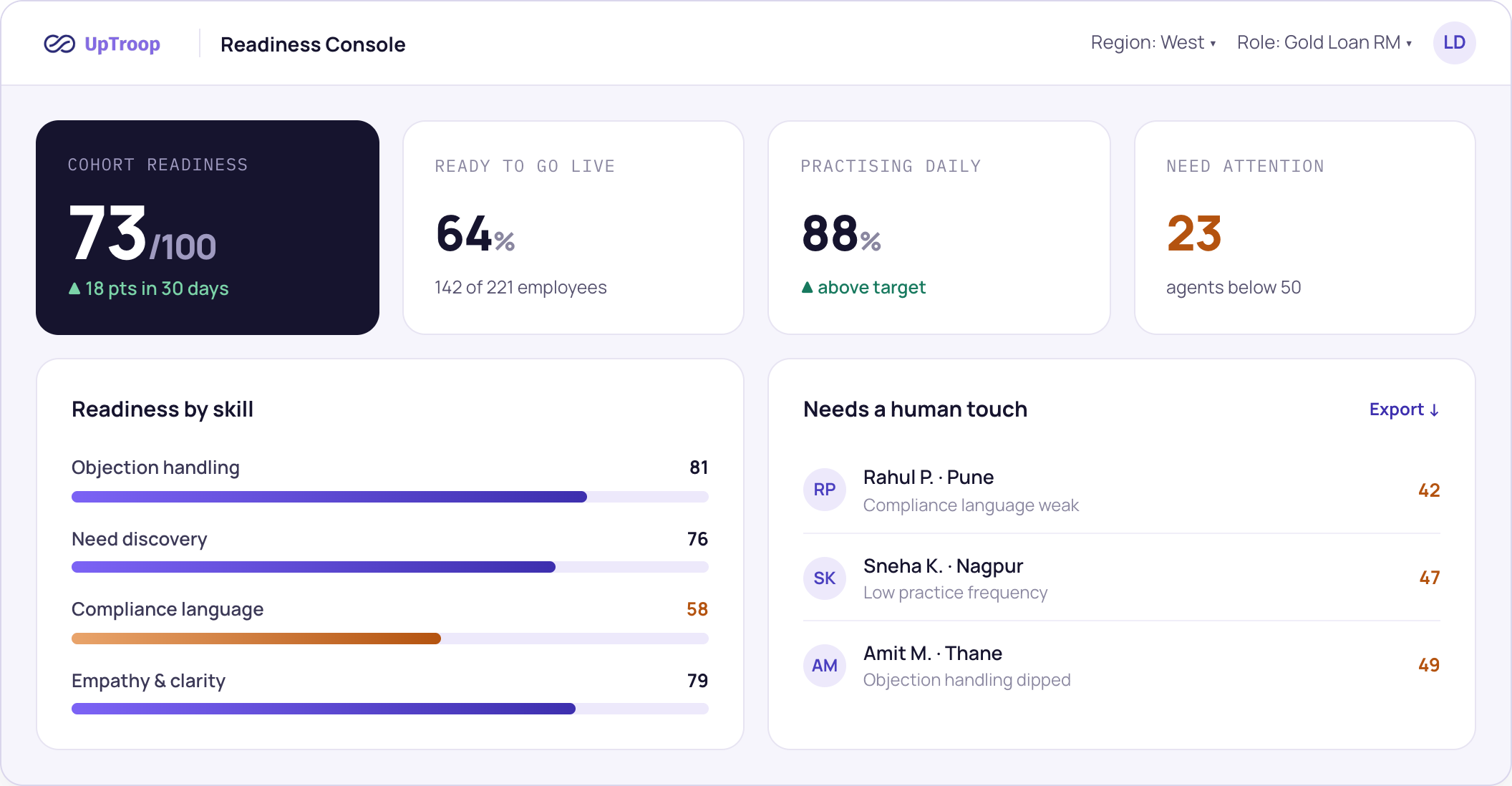
Leadership dashboards show — daily, by region, role and language:
- Who is ready and who is improving
- Where teams struggle (down to the specific scenario and skill)
- Which scenarios need reinforcement across a zone
Managers stopped chasing completion and started coaching exactly where the data pointed. The question changed from "did they finish the module?" to "can they handle the conversation?"
Rollout: enterprise scale, without the big-bang risk
The deployment ran in planned waves — first cohort live in under two weeks, then expanding by region, role and language, each wave with a frozen scope, readiness checks and a soft launch. Thousands of daily active practices within the first weeks, scaling toward the full 12,000-licence deployment — without overwhelming teams or support structures.
What Changed
Within weeks:
- New hires started contributing faster — measurably
- Conversations became structured and confident, in every language
- Objections and collections moments were handled with greater clarity and consistency
- Escalations and manager hand-holding reduced
Most importantly: performance improved in real customer interactions — not just in training metrics.
Client Voice
"We weren't struggling with training — we were struggling with consistency on the ground. UpTroop helped our teams practice real scenarios, not just learn concepts. That's where the shift happened."— Business Leader, Financial Services Enterprise
This wasn't a training problem. It was a readiness problem.
At 12,000-person scale, in eight languages, with scenarios the business itself curated — UpTroop shifted the organization from:
content → completion
to:practice → performance
See how your team performs in real scenarios · Book a 15-min demo