.png)

PLATFORM · FRONTLINE READINESS SYSTEM
UpTroop turns your existing SOPs, playbooks and compliance manuals into daily practice inside the flow of work — because training doesn't automatically translate into execution, and completion was never the same thing as being ready.
37%
faster ramp to productivity
14,000
frontline users in daily production use
11+
languages live in production
3x
speed to proficiency
HOW IT WORKS
You don't need to write anything new. Upload what already exists, and the system builds the practice around it.
SOPs, product decks, compliance manuals and training decks convert directly into role-specific practice scenarios and role plays.
Practice is tailored by role, level, outcome and language, because generic training doesn't hold up in a real conversation.
Frontline teams don't log into platforms between customers. Practice arrives in Microsoft Teams, WhatsApp, SMS or a lightweight web link instead.
Your LMS stays the system of record for knowledge. UpTroop is the layer that turns that knowledge into execution.

No — and it isn't trying to replace yours. An LMS delivers content and tracks completion. UpTroop is a readiness layer that sits alongside it: it turns your existing SOPs, playbooks and product content into daily voice-based practice, then measures whether your team can actually perform in a real conversation — not whether they clicked complete. LMS = knowledge. UpTroop = execution.

No laptops, no email IDs, no app downloads required. Learners access UpTroop through WhatsApp on their own phones — they receive a practice nudge, tap the link, verify with an OTP, and start practicing. The whole login takes under 10 seconds. Teams that prefer Microsoft Teams or Slack can use those instead.
Yes — that is the core of how UpTroop works. Upload your SOPs, product documents, sales scripts or compliance manuals, and the platform converts them into practice scenarios and role plays built on your actual customer situations — your products, your objections, your policies. Your team does not practice generic conversations; they practice the exact moments they will face tomorrow.
Yes. Every scenario, assignment, and journey tweak goes through your admin panel — you decide what gets built, who it goes to, and when. Nothing is generated or assigned as a black box.
Data for Indian enterprise deployments is hosted in India, with encryption in transit and at rest, role-based access controls, and tenant-level isolation. We work through each client’s security and risk assessment as part of onboarding, and our team supports Infosec reviews with architecture documentation and compliance responses. If your security team has a questionnaire, we have seen it before — send it over.
Yes — and this is where practice matters most. In regulated industries, what your team says is not just a sales skill, it is a compliance obligation. UpTroop scenarios can be built around your compliance requirements — mandatory disclosures, prohibited statements, process adherence — and every practice response is evaluated against them. Instead of discovering compliance gaps in an audit or a customer complaint, you see them in a readiness dashboard and fix them in practice, where mistakes are free.
In planned waves, not a big bang. A typical enterprise rollout starts with one cohort — a region, a role, a language — stabilizes it, then expands wave by wave until the full organization is live. Each wave has a frozen scope, its own readiness checks, and a soft launch before going wide. In our current enterprise deployment, users began practicing in languages ahead of their official rollout — on their own.
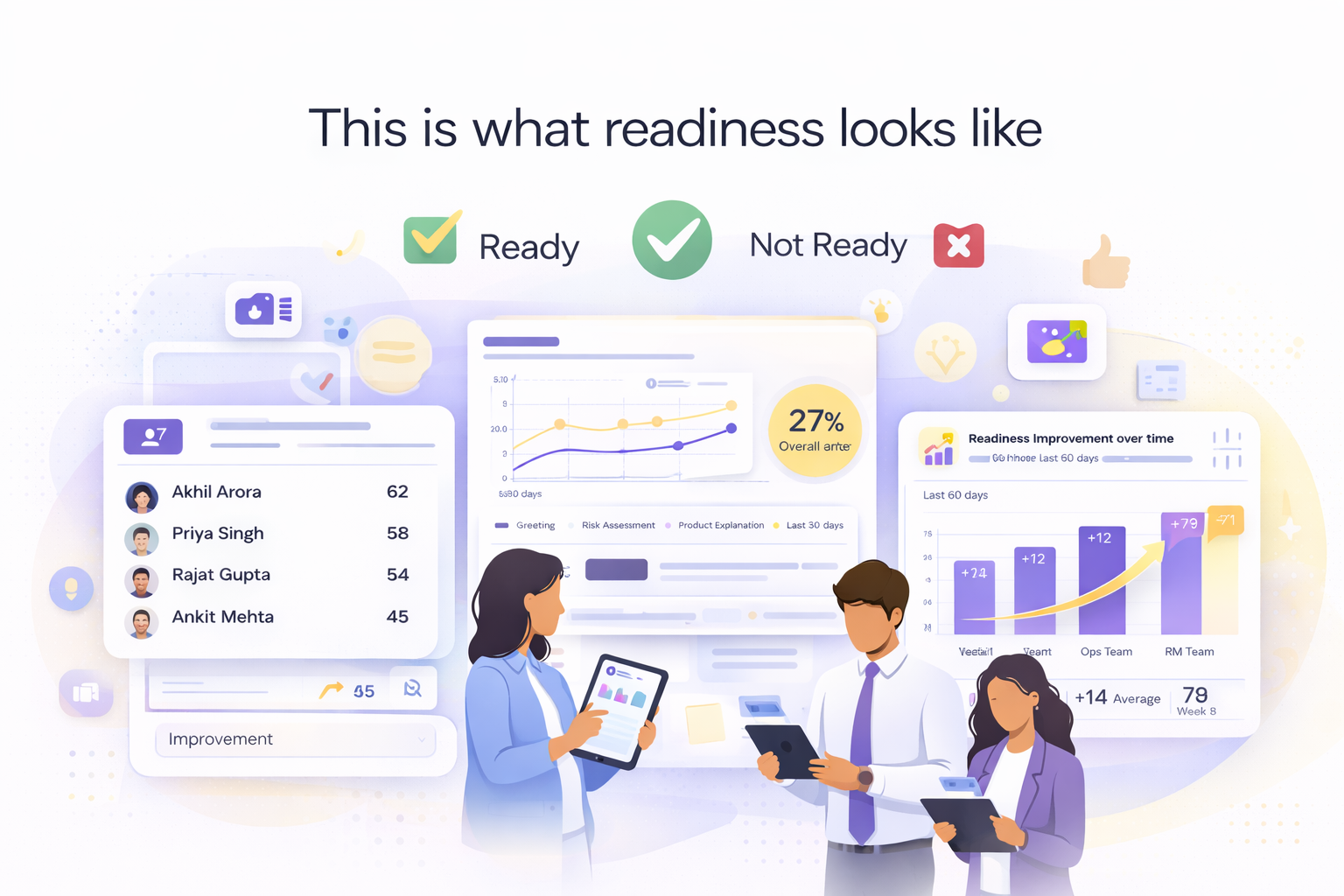
Learners typically notice their own improvement within days — practice is daily and feedback is immediate. Leaders see engagement and readiness movement in dashboards from week one. Pilots have shown 37% faster ramp to productivity and 3x speed to proficiency. In our current enterprise deployment, adoption picked up organically — users began practicing in languages ahead of their official rollout, on their own.
Enterprise pricing has two components: a per-licence subscription for your active users, and AI consumption units that cover AI-powered activities like role plays, video generation and coaching feedback. This keeps pricing aligned to actual usage rather than a flat fee for shelfware. We will walk you through a sizing estimate for your team in the first conversation — no surprises later.
Yes — most clients start with a paid 4-week pilot: a defined cohort, agreed success metrics, and a clear expansion path if the metrics are met. Pilots run on the full platform, not a demo version, so what you evaluate is exactly what you would scale. Our published outcome numbers — 37% faster ramp, 3x speed to proficiency — come from pilots structured this way.
Yes. SSO login, HRMS-driven user provisioning, LMS interoperability and reporting APIs are supported as enterprise integrations, scoped during onboarding based on your systems and requirements. Out of the box, UpTroop also works fully standalone — bulk user upload, OTP login, downloadable reports — so you can launch in days and add integrations as a second phase rather than making them a launch dependency.
SEE IT ON YOUR OWN SOPS
Fifteen minutes. We'll turn one of your SOPs into a scored practice scenario and show you the readiness view a manager would see in week one.