.png)

Why Automation Alone No Longer Wins Outbound — and What to Do Instead


Why Automation Alone No Longer Wins Outbound — and What to Do Instead
For the last five years, the dominant answer to outbound performance has been simple: automate more.
More sequences.
More AI-written emails.
More auto-follow-ups.
More tools.
And for a while, it worked.
Then something interesting happened.
Recently, Ramp — one of the best-run fintech companies in the world — publicly shared that it paused its internal AI SDR program after running it for years. According to a public post by co-founder Gene Lee, the system once drove nearly 30% of pipeline. But over time, returns plateaued as outbound fatigue set in and automation became table stakes.
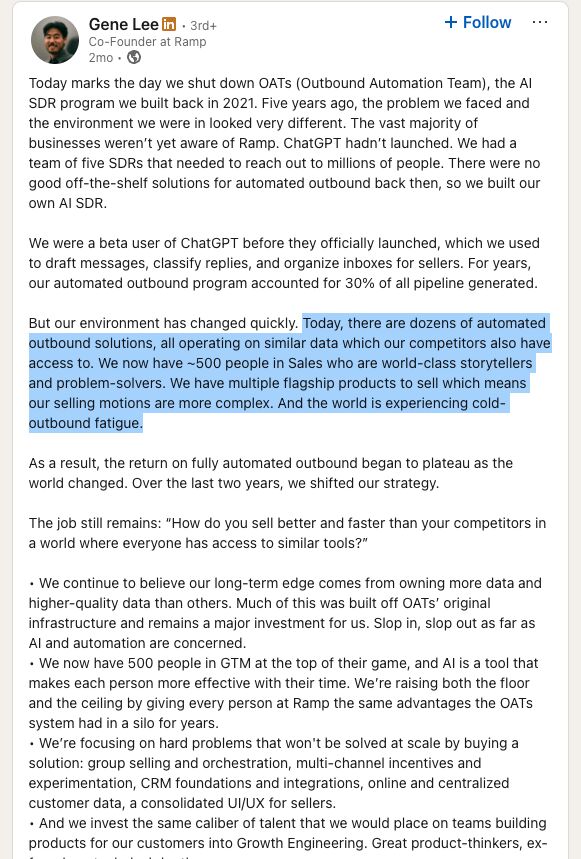
This wasn’t an AI failure.
It was a market maturity signal.
When everyone has access to the same automation, the advantage shifts elsewhere.
Where Automation Worked — and Where It Stopped
Let’s be clear: outbound automation isn’t useless.
It solved real problems:
- It reduced manual effort for SDR teams
- It standardized messaging at scale
- It helped early-stage teams punch above their weight
- It made experimentation cheaper and faster
But automation was always strongest before the human moment — not during it.
It could:
- Draft emails
- Trigger sequences
- Schedule touches
It could not:
- Handle live objections
- Adapt tone mid-call
- Navigate ambiguous buyer signals
- Exercise judgment when a deal went off-script
As outbound volumes exploded and inboxes filled with AI-generated sameness, buyers adapted. Response rates fell. Attention dropped. And fully automated outbound started delivering diminishing returns.
This is where many GTM teams are stuck today:
“We have more tools than ever — but deals aren’t moving faster.”
The Real Bottleneck: Human Execution at the Moment of Contact
Every outbound motion eventually hits the same point of truth:
A human interacts with another human.
That moment might be:
- A discovery call
- A follow-up after a demo
- A pricing objection
- A renewal risk conversation
- A compliance-sensitive response
And this is where most teams are underprepared.
Not because they lack knowledge.
Not because they lack tools.
But because they’ve never practiced the real scenarios they’re about to face.
Most enablement happens too far away from execution:
- Long onboarding programs
- Static playbooks
- Recorded trainings
- One-time certifications
What’s missing is the 10–15 minute window before action, where confidence is formed or lost.
Automation doesn’t solve this.
Content libraries don’t solve this.
Practice does.
Evidence from the Field: What Happens When Teams Practice
In pilots we’ve run with sales pods and contact-center queues, teams didn’t add more content or automation.
Instead, they did something deceptively simple:
- 10–15 minute micro-simulations
- Role-specific scenarios
- Embedded directly into daily workflows (Slack, Teams, WhatsApp)
- Repeated a few times a week
No webinars.
No long modules.
No LMS logins.
The outcomes were consistent across pilots:
- ~20–30% faster ramp for new joiners (conservative estimate)
- Improved QA scores within weeks
- Higher confidence on live calls, reported by reps themselves
- Fewer escalations caused by “I knew this, but froze in the moment”
These aren’t vanity metrics.
They’re operational outcomes business leaders care about.
And critically, these gains came without adding more tools.
The Shift Leaders Need to Make
The next phase of GTM performance isn’t about replacing humans with AI.
It’s about using AI to make humans better at execution.
That requires a shift in mindset:
From Old Questions >> to New Questions
“How do we automate more?” >> “How do we help people execute better?”
“Did they complete training?” >> “Can they handle the live scenario?”
“Did the message send?” >> “Did the rep respond correctly?”
“How many tools do we have?” >> “What actually changes behavior?”
This is where execution readiness becomes the real differentiator.
A Practical Playbook: From Automation to Execution Readiness
If you’re leading Sales, RevOps, Enablement, or L&D, here’s a practical way forward.
1. Identify High-Risk Moments
Map the moments where deals stall or escalate:
- First live objection
- Pricing conversations
- Compliance-sensitive responses
- Customer pushback after proposal
These are practice-worthy moments.
2. Design Micro-Simulations (Not Courses)
Each scenario should:
- Take 10–15 minutes max
- Be role-specific
- Mirror real conversations, not ideal ones
- Include immediate feedback
Think rehearsal, not training.
3. Embed Practice Where Work Happens
If practice requires logging into a new system, adoption will drop.
Embed it into:
- Slack
- Microsoft Teams
- CRM-triggered moments
Practice should feel like part of work — not extra work.
4. Repeat Lightly, Frequently
Confidence doesn’t come from one exposure.
It comes from:
- Short
- Repeated
- Contextual practice
Twice a week beats twice a quarter.
5. Measure What People Actually Do
Move beyond completion rates.
Track:
- Scenario performance
- Time to confident execution
- QA improvements
- Reduction in escalations
- Ramp time compression
That’s real ROI.
A One-Page Checklist for GTM Leaders
Use this to pressure-test your current approach:
- Do reps practice real scenarios before facing customers?
- Is practice short enough to fit into busy days?
- Is it embedded into tools they already use?
- Are outcomes measured beyond completion?
- Can new joiners execute confidently in week 2, not month 2?
If most answers are “no,” automation alone isn’t your bottleneck.
What This Means Going Forward
Ramp pausing its AI SDR program isn’t a warning against AI.
It’s a signal that the easy gains are gone.
The next edge comes from:
- Better judgment
- Better timing
- Better execution
- Better prepared humans
The companies that win won’t have fewer tools — they’ll have teams that know what to do when it matters most.
Want to Try This Without Overhauling Everything?
We’ve put together a 1-page pilot plan that shows how to run a low-risk, 7-day micro-simulation pilot for a single sales pod or queue — including:
- What to simulate
- How to embed it
- What to measure
- How to show ROI quickly
👉 Download the 1-page pilot plan for your sales pod
(Or email us hello@uptroop.io if you want it tailored to your context.)
See how AI role plays help sales teams practice these exact conversations.









.png)
